Coffee Brewing Methods: The Complete Expert Guide
Most home coffee tastes worse than it should, and the beans are rarely the reason. The same bag can give you a sweet, bright cup or a flat, bitter one depending entirely on how you brew it.
That “how” is the part you fully control. Grind, ratio, water temperature, and brew time decide whether you taste caramel and citrus or cardboard and ash.
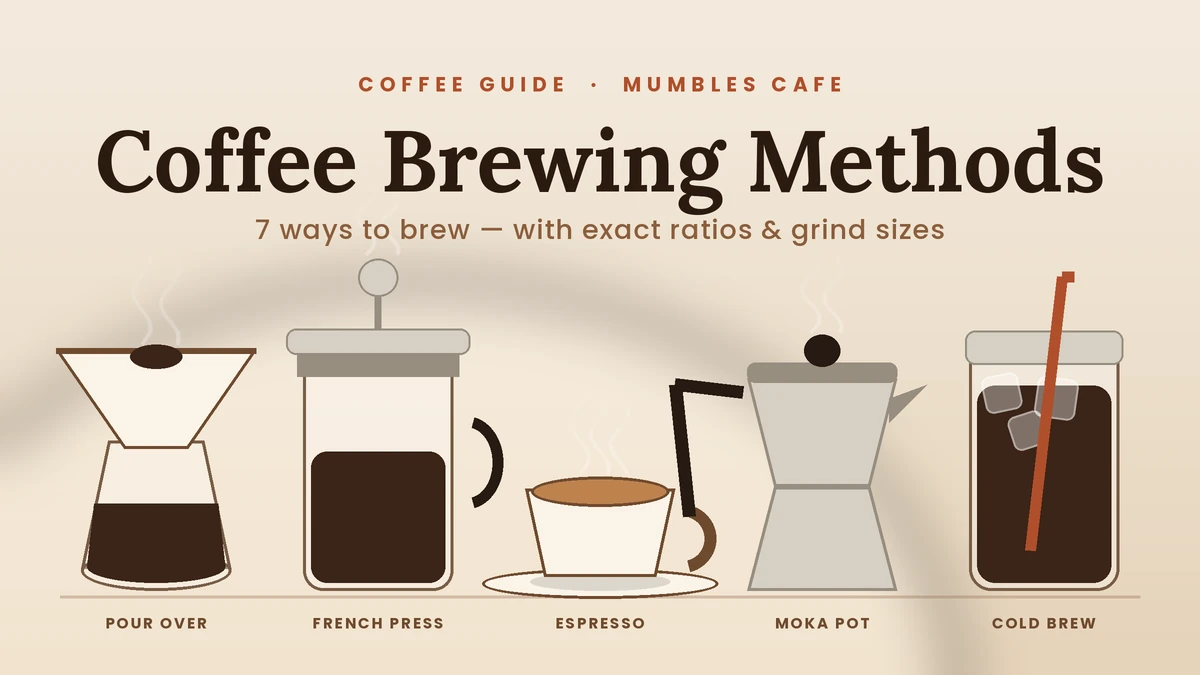
This guide covers the seven coffee brewing methods worth knowing: drip, pour over, French press, AeroPress, espresso, Moka pot, and cold brew. For each one you get the grind size, the exact coffee-to-water ratio we use behind the counter at Mumbles, the brew time, and the flavor you should expect. By the end you will know which method fits your mornings and how to dial it in.
What Actually Changes the Taste of Your Coffee
Brewing is just dissolving flavor out of ground coffee and into water. Coffee people call this extraction. Pull too little and the cup tastes sour and thin. Pull too much and it turns bitter and harsh.
Four variables do almost all the work, and every method is really just a different way of balancing them:
- Grind size controls how fast water gets to the flavor. Finer grinds extract faster; coarser grinds extract slower.
- Coffee-to-water ratio sets strength. We write it as 1:16, meaning one gram of coffee for every sixteen grams of water.
- Water temperature drives the speed of extraction. The sweet spot for hot brewing sits between 195°F and 205°F (90–96°C).
- Contact time is how long the water and grounds stay together, from 25 seconds for espresso to 18 hours for cold brew.
There is a standard behind this. The Specialty Coffee Association’s Golden Cup target is roughly 55 grams of coffee per liter of water (about 1:16.7), aiming for an extraction yield of 18–22%. Hit that window and the coffee tastes balanced and sweet. Miss it in either direction and you can taste the mistake.
Every brewing method below falls into one of two families. Immersion methods (French press, cold brew, most of an AeroPress brew) soak the grounds in water the whole time. Percolation methods (drip, pour over, espresso) pass fresh water through a bed of grounds and away. Immersion tends to give body and forgiveness; percolation tends to give clarity and control.
The 7 Coffee Brewing Methods, Explained
Here is each method with the numbers that matter. I’ve kept the ratios on the practical side of the SCA range, since that is what tastes best to most people on real beans.
1. Drip (Automatic Coffee Maker)
This is the workhorse of American kitchens, and the data backs it up. According to the National Coffee Association’s Fall 2025 report, 38% of past-day coffee drinkers used a drip brewer, more than any other method.
- Grind: Medium, like table salt
- Ratio: 1:16 to 1:17 (about 60g coffee per liter)
- Water temp: 195–205°F (a good machine handles this for you)
- Brew time: 4–6 minutes
- Tastes like: Clean, even, familiar. Hard to mess up.
A drip machine showers hot water over a flat or cone-shaped bed of grounds and lets gravity do the rest. It is hands-off and made for volume, which is why it wins on a busy weekday morning. The catch: cheap machines often brew too cool and never reach proper extraction, so the cup comes out weak no matter how much coffee you add. Look for a brewer that hits temperature and pulses the water rather than dumping it all at once.
2. Pour Over (V60, Chemex, Kalita)
If you want to actually taste where a coffee comes from, this is the method. Pour over is the same idea as drip, except your hand is the machine, which means you control everything.
- Grind: Medium-fine
- Ratio: 1:16 (try 15g coffee to 250g water for one cup)
- Water temp: 200°F, just off the boil
- Brew time: 2:30 to 3:30
- Tastes like: Bright, clean, tea-like clarity. Shows off acidity and origin character.
A paper filter traps the oils and fine particles, so the cup comes out delicate and transparent. That clarity is exactly why we brew our Ethiopian Yirgacheffe on a V60 in the cafe instead of an espresso machine; you lose the floral, citrus notes under pressure. The technique takes practice. Pour in slow, controlled circles, keep the water level steady, and finish the whole brew in around three minutes.
3. French Press
The most forgiving way to make genuinely good coffee with no skill and no electricity. A French press is pure immersion: grounds and water sit together, then a metal mesh plunger separates them.
- Grind: Coarse, like breadcrumbs or sea salt
- Ratio: 1:15
- Water temp: 200°F
- Brew time: 4 minutes, then plunge slowly
- Tastes like: Heavy, rich, full-bodied. You can almost chew it.
Because there is no paper filter, the coffee’s natural oils stay in the cup, which is what gives French press its weight. Steep for four minutes, plunge gently, and pour it all out right away. Leaving brewed coffee sitting on the grounds is the classic mistake; it keeps extracting and turns bitter within minutes.
4. AeroPress
A weird-looking plastic plunger that punches far above its price. The AeroPress mixes immersion with a gentle push of air pressure, and it is almost impossible to brew a bad cup with it.
- Grind: Medium-fine
- Ratio: Flexible, around 1:14 to 1:16 (a common start is 15g coffee to 230g water)
- Water temp: 175–205°F (lower temps work great here)
- Brew time: 1 to 2 minutes
- Tastes like: Smooth, clean, low acidity. Endlessly adjustable.
It is the method I recommend to anyone who travels or only makes one cup at a time. It is lightweight, rinses clean in seconds, and forgives sloppy technique. The downside is obvious: it only makes one mug per brew, so it is useless for a dinner party.
5. Espresso
The base of every latte, flat white, and cappuccino. Espresso forces near-boiling water through finely ground coffee at roughly nine bars of pressure, which is why it needs a real machine and a serious grinder.
- Grind: Very fine, like powdered sugar
- Ratio: 1:2 (18g of grounds in, about 36g of liquid out)
- Water temp: ~200°F at 9 bars of pressure
- Brew time: 25–30 seconds
- Tastes like: Intense, syrupy, concentrated, topped with crema.
Espresso is its own world. The pressure pulls out compounds that gentler methods leave behind, which is why a 36-gram shot punches so hard. It is also the least forgiving setup at home, since grind size needs adjusting almost daily as beans age. One myth worth killing: a single shot has less total caffeine than a full mug of drip, because the serving is tiny even though it is concentrated.
6. Moka Pot
The stovetop classic from Italy. A Moka pot pushes steam pressure up through grounds, landing somewhere between drip and espresso in strength.
- Grind: Fine to medium-fine
- Ratio: Roughly 1:10 to 1:12 (fill the basket level, don’t tamp)
- Heat: Medium, never full blast
- Brew time: 4–5 minutes
- Tastes like: Bold, strong, espresso-adjacent.
It makes a powerful cup for the price of a kettle. The trick is to pull it off the heat the moment you hear that gurgling hiss, which is the sound of the water running out. Push it past that point and you scorch the coffee into something bitter and metallic.
7. Cold Brew
Not the same thing as iced coffee. Cold brew never touches heat; it steeps coarse grounds in cold or room-temperature water for many hours, which is what makes it so smooth.
- Grind: Extra coarse
- Ratio: 1:8 for ready-to-drink, or 1:4 to 1:5 for a concentrate you dilute later
- Water temp: Cold or room temperature
- Brew time: 12 to 18 hours
- Tastes like: Smooth, sweet, chocolatey, very low acidity.
Without heat, the acidic and bitter compounds barely dissolve, so cold brew tastes mellow and naturally sweet. It is the fastest-growing category in the country for a reason: NCA data shows cold coffee drinks jumped sharply over the past five years. Make a concentrate in a jar, strain it through a paper filter, and it keeps in the fridge for about a week.
For the full method, see our guide on how to make cold brew coffee at home.
How to Choose the Right Brewing Method for You
There is no single best method. There is the best method for your morning, your patience, and your taste. Here is the whole comparison in one place.
| Method | Grind | Ratio | Brew Time | Body & Flavor |
|---|---|---|---|---|
| Drip | Medium | 1:16–1:17 | 4–6 min | Clean, balanced, easy |
| Pour Over | Medium-fine | 1:16 | 2:30–3:30 | Bright, clear, nuanced |
| French Press | Coarse | 1:15 | 4 min | Heavy, rich, full |
| AeroPress | Medium-fine | 1:14–1:16 | 1–2 min | Smooth, clean, low acid |
| Espresso | Very fine | 1:2 | 25–30 sec | Intense, syrupy |
| Moka Pot | Fine-medium | 1:10–1:12 | 4–5 min | Bold, strong |
| Cold Brew | Extra coarse | 1:8 (or 1:4 concentrate) | 12–18 hrs | Smooth, sweet, mellow |
A few quick rules I give customers who ask:
- You want easy and reliable every day: drip or French press.
- You want to taste a special single-origin bag: pour over.
- You make one cup and you’re often traveling: AeroPress.
- You drink milk-based coffee: espresso, no way around it.
- You can’t stand bitterness or acidity: cold brew.
And whatever you pick, two upgrades matter more than the gear itself. Buy a kitchen scale and weigh your coffee and water in grams. Buy a burr grinder and grind right before you brew. Those two changes do more for a cup than a $1,000 espresso machine ever will.
Common Coffee Brewing Mistakes and Myths
I taste a lot of home-brewing disasters, and the same handful of errors cause almost all of them.
Measuring by scoops instead of weight. A tablespoon of light-roast beans and a tablespoon of dark-roast grounds weigh completely different amounts. Volume is the single biggest reason home coffee is inconsistent from one day to the next. Weigh in grams and your cup becomes repeatable overnight.
Pouring boiling water straight onto the grounds. Water at a rolling boil over-extracts and scorches, which reads as bitter. Take the kettle off the heat and let it rest 30 to 45 seconds before pouring.
Using stale, pre-ground coffee. Ground coffee goes flat within days as it oxidizes. Whole beans ground fresh are the difference between aroma and nothing.
Ignoring your water. Coffee is about 98% water, so heavily chlorinated tap water tastes like heavily chlorinated tap water. Filtered water is a cheap fix.
Two stubborn myths are worth correcting too. Dark roast does not contain dramatically more caffeine than light roast; by weight they are very close, and light roast is arguably a hair higher. And an expensive machine does not guarantee a good cup. Grind quality and ratio decide far more than the price tag on your brewer.
Read More: Café Bustelo Coffee: Flavor, Brewing & Complete Guide
Frequently Asked Questions
What is the easiest coffee brewing method for beginners? A French press or an AeroPress. Both are nearly impossible to ruin, need no special skill, and cost very little. You add coarse-to-medium grounds and hot water, wait a few minutes, then press. No timing precision or pouring technique required to get a solid cup.
Which brewing method makes the strongest coffee? By concentration, espresso wins, followed by a Moka pot and undiluted cold brew concentrate. But “strong” and “high caffeine” are not the same. A small espresso shot is concentrated yet holds less total caffeine than a large mug of drip coffee, simply because of serving size.
What is the best coffee-to-water ratio? Start at 1:16, meaning one gram of coffee per sixteen grams of water. The SCA Golden Cup range runs from about 1:15 to 1:18. Use less water for a stronger cup, more for a milder one, and adjust by a gram or two at a time until it tastes right.
Does the brewing method change the caffeine? Yes. Longer contact time and finer grinds pull out more caffeine, which is why a long cold brew steep yields a potent concentrate. Espresso is concentrated but served small. The cup with the most caffeine is usually a large drip or cold brew, not an espresso.
Which brewing method is the healthiest? Paper-filtered methods like pour over and drip remove most cafestol, an oily compound in coffee linked to raised LDL cholesterol. Unfiltered methods such as French press, espresso, and Moka pot let more of it through. For most people the difference is minor, but it matters if your cholesterol runs high.
Pour over vs French press, which should I use? It comes down to clarity versus body. Pour over uses a paper filter for a clean, bright cup that highlights delicate flavors. French press keeps the oils for a heavier, richer mouthfeel. Choose pour over for nuanced single origins and French press for bold, comforting everyday coffee.
Do I really need a burr grinder? For consistent coffee, yes. Blade grinders chop beans into uneven chunks and dust, which extract at different rates and muddy the flavor. A burr grinder produces even particles, and it is the upgrade that changes your coffee the most for the money.
Final Pour
The best coffee brewing methods are not about owning the most gear. They are about understanding four things, grind, ratio, temperature, and time, and choosing the method that fits your life. A French press for a slow Sunday, an AeroPress for the road, a pour over when a special bag deserves attention.
Pick one method this week and brew it the same way three days running, weighing everything. You will taste your own consistency improve faster than you expect.
If you would rather have someone else dial it in, that is our whole job. We roast every week in Fitzroy and brew each of these methods to order. Come taste the difference, or grab a bag of our fresh single-origin beans to take your new ratios home.
Most home coffee tastes worse than it should, and the beans are rarely the reason. The same bag can give you a sweet, bright cup or a flat, bitter one depending entirely on how you brew it.
That “how” is the part you fully control. Grind, ratio, water temperature, and brew time decide whether you taste caramel and citrus or cardboard and ash.
This guide covers the seven coffee brewing methods worth knowing: drip, pour over, French press, AeroPress, espresso, Moka pot, and cold brew. For each one you get the grind size, the exact coffee-to-water ratio we use behind the counter at Mumbles, the brew time, and the flavor you should expect. By the end you will know which method fits your mornings and how to dial it in.
What Actually Changes the Taste of Your Coffee
Brewing is just dissolving flavor out of ground coffee and into water. Coffee people call this extraction. Pull too little and the cup tastes sour and thin. Pull too much and it turns bitter and harsh.
Four variables do almost all the work, and every method is really just a different way of balancing them:
- Grind size controls how fast water gets to the flavor. Finer grinds extract faster; coarser grinds extract slower.
- Coffee-to-water ratio sets strength. We write it as 1:16, meaning one gram of coffee for every sixteen grams of water.
- Water temperature drives the speed of extraction. The sweet spot for hot brewing sits between 195°F and 205°F (90–96°C).
- Contact time is how long the water and grounds stay together, from 25 seconds for espresso to 18 hours for cold brew.
There is a standard behind this. The Specialty Coffee Association’s Golden Cup target is roughly 55 grams of coffee per liter of water (about 1:16.7), aiming for an extraction yield of 18–22%. Hit that window and the coffee tastes balanced and sweet. Miss it in either direction and you can taste the mistake.
Every brewing method below falls into one of two families. Immersion methods (French press, cold brew, most of an AeroPress brew) soak the grounds in water the whole time. Percolation methods (drip, pour over, espresso) pass fresh water through a bed of grounds and away. Immersion tends to give body and forgiveness; percolation tends to give clarity and control.
The 7 Coffee Brewing Methods, Explained
Here is each method with the numbers that matter. I’ve kept the ratios on the practical side of the SCA range, since that is what tastes best to most people on real beans.
1. Drip (Automatic Coffee Maker)
This is the workhorse of American kitchens, and the data backs it up. According to the National Coffee Association’s Fall 2025 report, 38% of past-day coffee drinkers used a drip brewer, more than any other method.
- Grind: Medium, like table salt
- Ratio: 1:16 to 1:17 (about 60g coffee per liter)
- Water temp: 195–205°F (a good machine handles this for you)
- Brew time: 4–6 minutes
- Tastes like: Clean, even, familiar. Hard to mess up.
A drip machine showers hot water over a flat or cone-shaped bed of grounds and lets gravity do the rest. It is hands-off and made for volume, which is why it wins on a busy weekday morning. The catch: cheap machines often brew too cool and never reach proper extraction, so the cup comes out weak no matter how much coffee you add. Look for a brewer that hits temperature and pulses the water rather than dumping it all at once.
2. Pour Over (V60, Chemex, Kalita)
If you want to actually taste where a coffee comes from, this is the method. Pour over is the same idea as drip, except your hand is the machine, which means you control everything.
- Grind: Medium-fine
- Ratio: 1:16 (try 15g coffee to 250g water for one cup)
- Water temp: 200°F, just off the boil
- Brew time: 2:30 to 3:30
- Tastes like: Bright, clean, tea-like clarity. Shows off acidity and origin character.
A paper filter traps the oils and fine particles, so the cup comes out delicate and transparent. That clarity is exactly why we brew our Ethiopian Yirgacheffe on a V60 in the cafe instead of an espresso machine; you lose the floral, citrus notes under pressure. The technique takes practice. Pour in slow, controlled circles, keep the water level steady, and finish the whole brew in around three minutes.
3. French Press
The most forgiving way to make genuinely good coffee with no skill and no electricity. A French press is pure immersion: grounds and water sit together, then a metal mesh plunger separates them.
- Grind: Coarse, like breadcrumbs or sea salt
- Ratio: 1:15
- Water temp: 200°F
- Brew time: 4 minutes, then plunge slowly
- Tastes like: Heavy, rich, full-bodied. You can almost chew it.
Because there is no paper filter, the coffee’s natural oils stay in the cup, which is what gives French press its weight. Steep for four minutes, plunge gently, and pour it all out right away. Leaving brewed coffee sitting on the grounds is the classic mistake; it keeps extracting and turns bitter within minutes.
4. AeroPress
A weird-looking plastic plunger that punches far above its price. The AeroPress mixes immersion with a gentle push of air pressure, and it is almost impossible to brew a bad cup with it.
- Grind: Medium-fine
- Ratio: Flexible, around 1:14 to 1:16 (a common start is 15g coffee to 230g water)
- Water temp: 175–205°F (lower temps work great here)
- Brew time: 1 to 2 minutes
- Tastes like: Smooth, clean, low acidity. Endlessly adjustable.
It is the method I recommend to anyone who travels or only makes one cup at a time. It is lightweight, rinses clean in seconds, and forgives sloppy technique. The downside is obvious: it only makes one mug per brew, so it is useless for a dinner party.
5. Espresso
The base of every latte, flat white, and cappuccino. Espresso forces near-boiling water through finely ground coffee at roughly nine bars of pressure, which is why it needs a real machine and a serious grinder.
- Grind: Very fine, like powdered sugar
- Ratio: 1:2 (18g of grounds in, about 36g of liquid out)
- Water temp: ~200°F at 9 bars of pressure
- Brew time: 25–30 seconds
- Tastes like: Intense, syrupy, concentrated, topped with crema.
Espresso is its own world. The pressure pulls out compounds that gentler methods leave behind, which is why a 36-gram shot punches so hard. It is also the least forgiving setup at home, since grind size needs adjusting almost daily as beans age. One myth worth killing: a single shot has less total caffeine than a full mug of drip, because the serving is tiny even though it is concentrated.
6. Moka Pot
The stovetop classic from Italy. A Moka pot pushes steam pressure up through grounds, landing somewhere between drip and espresso in strength.
- Grind: Fine to medium-fine
- Ratio: Roughly 1:10 to 1:12 (fill the basket level, don’t tamp)
- Heat: Medium, never full blast
- Brew time: 4–5 minutes
- Tastes like: Bold, strong, espresso-adjacent.
It makes a powerful cup for the price of a kettle. The trick is to pull it off the heat the moment you hear that gurgling hiss, which is the sound of the water running out. Push it past that point and you scorch the coffee into something bitter and metallic.
7. Cold Brew
Not the same thing as iced coffee. Cold brew never touches heat; it steeps coarse grounds in cold or room-temperature water for many hours, which is what makes it so smooth.
- Grind: Extra coarse
- Ratio: 1:8 for ready-to-drink, or 1:4 to 1:5 for a concentrate you dilute later
- Water temp: Cold or room temperature
- Brew time: 12 to 18 hours
- Tastes like: Smooth, sweet, chocolatey, very low acidity.
Without heat, the acidic and bitter compounds barely dissolve, so cold brew tastes mellow and naturally sweet. It is the fastest-growing category in the country for a reason: NCA data shows cold coffee drinks jumped sharply over the past five years. Make a concentrate in a jar, strain it through a paper filter, and it keeps in the fridge for about a week.
How to Choose the Right Brewing Method for You
There is no single best method. There is the best method for your morning, your patience, and your taste. Here is the whole comparison in one place.
| Method | Grind | Ratio | Brew Time | Body & Flavor |
|---|---|---|---|---|
| Drip | Medium | 1:16–1:17 | 4–6 min | Clean, balanced, easy |
| Pour Over | Medium-fine | 1:16 | 2:30–3:30 | Bright, clear, nuanced |
| French Press | Coarse | 1:15 | 4 min | Heavy, rich, full |
| AeroPress | Medium-fine | 1:14–1:16 | 1–2 min | Smooth, clean, low acid |
| Espresso | Very fine | 1:2 | 25–30 sec | Intense, syrupy |
| Moka Pot | Fine-medium | 1:10–1:12 | 4–5 min | Bold, strong |
| Cold Brew | Extra coarse | 1:8 (or 1:4 concentrate) | 12–18 hrs | Smooth, sweet, mellow |
A few quick rules I give customers who ask:
- You want easy and reliable every day: drip or French press.
- You want to taste a special single-origin bag: pour over.
- You make one cup and you’re often traveling: AeroPress.
- You drink milk-based coffee: espresso, no way around it.
- You can’t stand bitterness or acidity: cold brew.
And whatever you pick, two upgrades matter more than the gear itself. Buy a kitchen scale and weigh your coffee and water in grams. Buy a burr grinder and grind right before you brew. Those two changes do more for a cup than a $1,000 espresso machine ever will.
Common Coffee Brewing Mistakes and Myths
I taste a lot of home-brewing disasters, and the same handful of errors cause almost all of them.
Measuring by scoops instead of weight. A tablespoon of light-roast beans and a tablespoon of dark-roast grounds weigh completely different amounts. Volume is the single biggest reason home coffee is inconsistent from one day to the next. Weigh in grams and your cup becomes repeatable overnight.
Pouring boiling water straight onto the grounds. Water at a rolling boil over-extracts and scorches, which reads as bitter. Take the kettle off the heat and let it rest 30 to 45 seconds before pouring.
Using stale, pre-ground coffee. Ground coffee goes flat within days as it oxidizes. Whole beans ground fresh are the difference between aroma and nothing.
Ignoring your water. Coffee is about 98% water, so heavily chlorinated tap water tastes like heavily chlorinated tap water. Filtered water is a cheap fix.
Two stubborn myths are worth correcting too. Dark roast does not contain dramatically more caffeine than light roast; by weight they are very close, and light roast is arguably a hair higher. And an expensive machine does not guarantee a good cup. Grind quality and ratio decide far more than the price tag on your brewer.
Frequently Asked Questions
What is the easiest coffee brewing method for beginners? A French press or an AeroPress. Both are nearly impossible to ruin, need no special skill, and cost very little. You add coarse-to-medium grounds and hot water, wait a few minutes, then press. No timing precision or pouring technique required to get a solid cup.
Which brewing method makes the strongest coffee? By concentration, espresso wins, followed by a Moka pot and undiluted cold brew concentrate. But “strong” and “high caffeine” are not the same. A small espresso shot is concentrated yet holds less total caffeine than a large mug of drip coffee, simply because of serving size.
What is the best coffee-to-water ratio? Start at 1:16, meaning one gram of coffee per sixteen grams of water. The SCA Golden Cup range runs from about 1:15 to 1:18. Use less water for a stronger cup, more for a milder one, and adjust by a gram or two at a time until it tastes right.
Does the brewing method change the caffeine? Yes. Longer contact time and finer grinds pull out more caffeine, which is why a long cold brew steep yields a potent concentrate. Espresso is concentrated but served small. The cup with the most caffeine is usually a large drip or cold brew, not an espresso.
Which brewing method is the healthiest? Paper-filtered methods like pour over and drip remove most cafestol, an oily compound in coffee linked to raised LDL cholesterol. Unfiltered methods such as French press, espresso, and Moka pot let more of it through. For most people the difference is minor, but it matters if your cholesterol runs high.
Pour over vs French press, which should I use? It comes down to clarity versus body. Pour over uses a paper filter for a clean, bright cup that highlights delicate flavors. French press keeps the oils for a heavier, richer mouthfeel. Choose pour over for nuanced single origins and French press for bold, comforting everyday coffee.
Do I really need a burr grinder? For consistent coffee, yes. Blade grinders chop beans into uneven chunks and dust, which extract at different rates and muddy the flavor. A burr grinder produces even particles, and it is the upgrade that changes your coffee the most for the money.
Final Pour
The best coffee brewing methods are not about owning the most gear. They are about understanding four things, grind, ratio, temperature, and time, and choosing the method that fits your life. A French press for a slow Sunday, an AeroPress for the road, a pour over when a special bag deserves attention.
Pick one method this week and brew it the same way three days running, weighing everything. You will taste your own consistency improve faster than you expect.
If you would rather have someone else dial it in, that is our whole job. We roast every week in Fitzroy and brew each of these methods to order. Come taste the difference, or grab a bag of our fresh single-origin beans to take your new ratios home.
Order our single-origin beans and taste the freshest roast Melbourne has to offer.