
Expert Guide to Coffee and Blood Pressure: What the Science Says
For decades, people with high blood pressure were told to cut back on coffee.
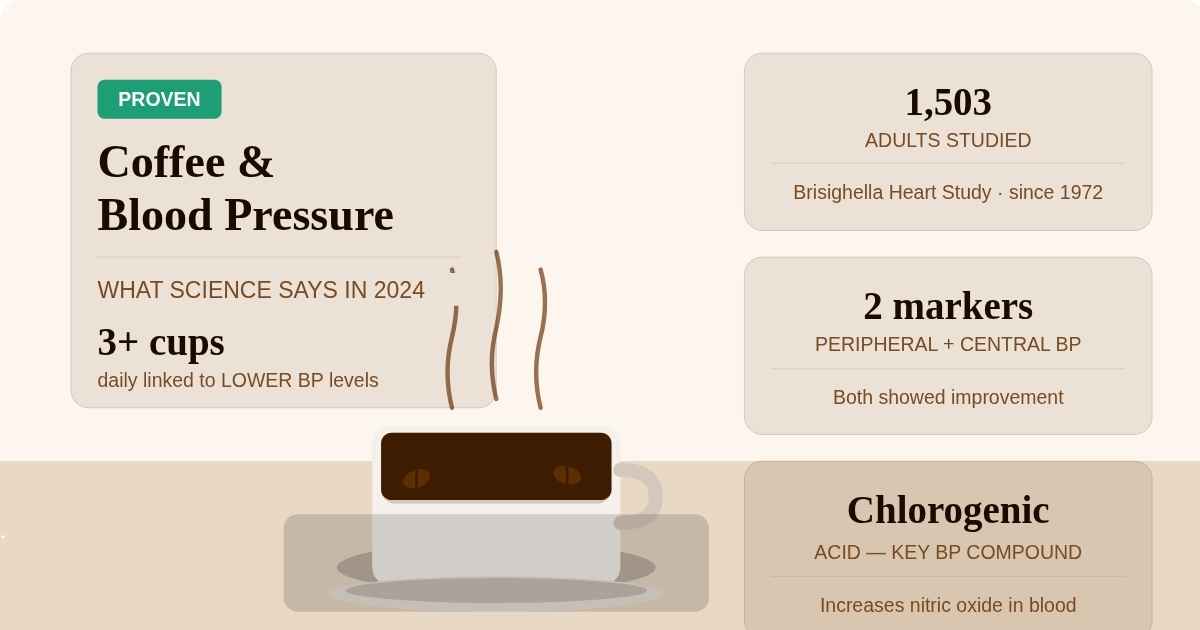
The logic was simple — caffeine raises blood pressure, so coffee must be bad for it. But a growing body of research is challenging that assumption. A 2024 study published in the journal Nutrients found that drinking three or more cups of coffee daily was actually linked to lower blood pressure — not higher.
This article breaks down what the research found, why coffee may help rather than hurt, and what it means for people managing hypertension today.
What the Study Found
The research was led by Dr. Arrigo F.G. Cicero, associate professor at the University of Bologna, using data from the Brisighella Heart Study — one of Europe’s longest-running cardiovascular studies, active since 1972. The sample included 720 men and 783 women from a rural town in northern Italy.
The key finding: regular coffee drinkers showed lower peripheral blood pressure (measured at the arm) and lower central blood pressure (measured closer to the heart at the aorta). Central blood pressure is considered a more accurate marker of cardiovascular risk than a standard arm reading. Both are also indicators of arterial stiffness — a condition that worsens with age and drives up systolic pressure in older adults.
Dr. Cicero’s conclusion was direct: “The trend from 2 cups of coffee per day appears to be positive. Coffee drinking should not be prohibited in current coffee drinkers if there is a fear that coffee may increase BP levels.”
Why Coffee Can Lower Blood Pressure
Coffee is not just caffeine. It contains hundreds of bioactive compounds, and several of them actively work to lower blood pressure — counteracting caffeine’s short-term spike.
The most important compound is chlorogenic acid. It is present in the highest concentration of any compound in coffee beans. When gut bacteria process it, it breaks down into metabolites that increase nitric oxide in the bloodstream. Nitric oxide relaxes and dilates blood vessel walls — directly reducing blood pressure. This mechanism has been demonstrated in animal studies and is considered one of the primary pathways through which coffee benefits cardiovascular health.
Quercetin is another relevant compound. It is an antioxidant flavonoid that may reduce vascular inflammation and support arterial flexibility — both factors in long-term blood pressure control.
Dr. Megan K. Rhodes, postdoctoral scholar in the Department of Nephrology at the University of Alabama at Birmingham, explained it this way: “Coffee contains caffeine, which can raise and lower blood pressure in acute settings, but it also contains antioxidants and bioactive compounds that may be responsible for the blood pressure-lowering effect.”
Dr. Debabrata Mukherjee, chair of the department of internal medicine at Texas Tech University Health Sciences Center El Paso, added that the net result of all these compounds together is neutral-to-positive for most regular coffee drinkers, even when caffeine is factored in.
What This Means for People with High Blood Pressure
Dr. Jim Liu, a cardiologist at The Ohio State University Wexner Medical Center, reviewed the study findings and said they are consistent with prior research. His position: “Coffee can acutely raise blood pressure after consumption, but there is really no solid evidence to show that moderate amounts of coffee cause long-term problems with high blood pressure or heart disease in general.”
For patients already drinking moderate amounts of coffee, he said the study offers reassurance that continuing is unlikely to negatively affect blood pressure — and may actually help it.
Dr. Mukherjee defined “moderate” as roughly four to five cups per day. He was clear, however, that this does not apply to people with existing severe hypertension, for whom restriction is still advisable.
The American Heart Association continues to advise against drinking “too much” coffee, noting risks including insomnia, heart palpitations, and anxiety alongside blood pressure concerns. The distinction between moderate and excessive consumption is where the science draws the line.
Common Myths vs. What the Evidence Shows
Myth: Coffee always raises blood pressure.
Fact: Caffeine causes a short-term spike, but regular drinkers build tolerance to this effect. Long-term data consistently points toward lower or neutral blood pressure with habitual moderate consumption.
Myth: Anyone with hypertension should avoid coffee entirely.
Fact: Moderate intake appears safe for most people with high blood pressure. Only those with severe hypertension are advised to restrict it — and even then, the guidance is to consult a physician, not to eliminate it outright.
Myth: Decaf is the only safe option for blood pressure.
Fact: The compounds most associated with BP reduction — chlorogenic acid and quercetin — are present in regular coffee too. Caffeine is only one part of the picture.
Myth: Drinking more coffee means lower blood pressure.
Fact: The beneficial range appears to be two to five cups per day. Excessive intake reintroduces risks: insomnia, palpitations, and anxiety — all of which can indirectly affect cardiovascular health.
FAQ
Q: Does coffee raise or lower blood pressure?
A: Both, depending on timing and frequency. A single cup raises BP acutely for one to three hours. But regular drinkers build tolerance to this spike. Long-term evidence, including this 2024 study, links three or more cups daily to lower peripheral and central blood pressure.
Q: How many cups of coffee is safe for high blood pressure?
A: Most experts point to three to five cups per day as the moderate range where benefits appear without significant risk. People with severe hypertension should consult their doctor before increasing intake.
Q: What compound in coffee lowers blood pressure?
A: Chlorogenic acid is the primary candidate. Gut bacteria convert it into metabolites that increase nitric oxide, which relaxes blood vessel walls. Quercetin, another coffee antioxidant, may also contribute through anti-inflammatory effects.
Q: Can I drink coffee if I’m on blood pressure medication?
A: Generally yes, in moderate amounts — but confirm with your prescribing physician. Some medications interact with caffeine, and individual health profiles vary.
Q: Does decaf coffee also lower blood pressure?
A: Potentially. Decaf retains chlorogenic acid and quercetin while removing the caffeine spike. Direct evidence for decaf’s BP effects is less robust than for regular coffee, but the mechanism is plausible.
Q: What does the American Heart Association say about coffee and BP?
A: The AHA advises against “too much” coffee due to blood pressure and other cardiovascular concerns. It does not prohibit moderate consumption. The guidance aligns with the research: moderation is the safe zone for most adults.
Q: Is the Brisighella Heart Study reliable?
A: It is one of Europe’s longest-running cardiovascular studies, active since 1972 — which gives it significant longitudinal credibility. Its main limitation is geographic focus on a single Italian town, which limits how broadly the results generalize to other populations.
Read More: Black Coffee on Empty Stomach: Benefits, Risks & Expert Tips
Conclusion
The science on coffee and blood pressure has shifted. The old blanket advice — avoid coffee if you have high BP — was based on caffeine’s acute effect in isolation. The full picture is more nuanced.
Three or more cups of coffee daily was linked to lower blood pressure markers in a well-designed study of over 1,500 adults. The compounds responsible, primarily chlorogenic acid, work through nitric oxide pathways that directly relax blood vessels. Multiple independent cardiologists reviewed these findings and called them consistent with prior evidence.
If you have high blood pressure and currently drink coffee in moderate amounts, the evidence does not support stopping. If you have severe hypertension, speak with your doctor before making any changes. And if you’re not a coffee drinker looking for a reason to start — the evidence supports moderate consumption as safe, but it is not a treatment for hypertension.
Keep your day productive — work from Mumbles with fast WiFi and bottomless inspiration.