
The Complete Guide to Van Gogh’s Café Terrace at Night
What Makes This Painting So Unusual for Its Time
Most 19th-century artists avoided painting at night altogether. Artificial lighting was unpredictable, colors shifted under gas lamps, and working outdoors after dark was simply impractical.
Van Gogh ignored all of that.
In September 1888, he set up his easel on the Place du Forum in Arles, France — and painted Café Terrace at Night directly from life, under the actual night sky. No studio. No sketches finished later in controlled light. Just the scene, the stars, and his brushes.
That decision alone separates this work from nearly everything being made in Europe at the time.
The Color Rule Van Gogh Broke on Purpose
Here’s what most people don’t know: Van Gogh deliberately used zero black paint in this entire painting.
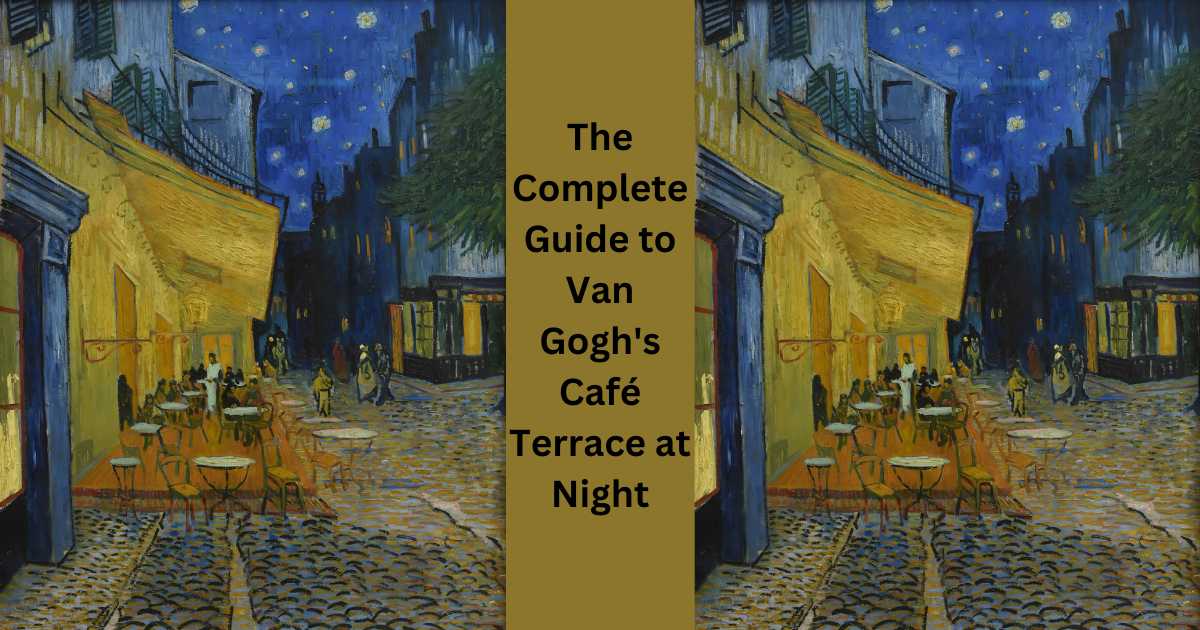
For shadows, dark alleys, and the night sky itself, he used deep cobalt blues, Prussian greens, and layered purples. The result is a darkness that still feels alive — not dead or flat.
He wrote about this directly to his sister Wilhelmina. He wanted to express the night using color alone — not by painting darkness, but by painting light competing with darkness.
This wasn’t accidental experimentation. Van Gogh had been studying color theory seriously, particularly the work of French chemist Michel Eugène Chevreul on simultaneous contrast — how colors placed next to each other intensify each other’s vibrancy.
The golden-yellow terrace against deep blue cobblestone isn’t just beautiful. It’s calculated.
Breaking Down the Composition Layer by Layer
The Foreground — The Terrace
The café terrace dominates the lower half. Warm amber and cadmium yellow tables pull the viewer in immediately. Patrons are present but deliberately vague — Van Gogh wasn’t interested in portraiture here. The mood of community mattered more than individual faces.
The Middle Ground — The Street
A lone cobblestone street cuts diagonally toward the background. This is Van Gogh’s perspective trick — it creates depth and pulls your eye inward. The street is mostly empty, which creates a quiet tension against the busy café.
The Background — The Sky
The upper third is pure sky, thick with stars rendered in impasto strokes. Each star has a halo of yellowish light, painted with such heavy texture you can almost feel the brushwork from across a room.
The three zones work together as contrast: warmth vs. cool, crowd vs. solitude, earth vs. cosmos.
The Symbolism That Keeps Art Historians Arguing
On the surface, this is a painting of people enjoying coffee on a Friday night. But several layers underneath, things get more complicated.
The Last Supper Theory
A group of art historians, most notably Kathleen Powers Erickson in her 1998 study, noted a striking compositional similarity to Leonardo da Vinci’s Last Supper. A central figure in white stands surrounded by exactly twelve other figures seated or standing around the terrace.
Van Gogh never confirmed this in his letters. But he did write frequently about religion, spirituality, and his complicated relationship with Christianity. Whether intentional or subconscious, the parallel is difficult to dismiss entirely.
Stars as Spiritual Language
In letters to his brother Theo, Van Gogh repeatedly used stars as metaphors for death, eternity, and what comes after life. He once wrote that just as we take a train to reach a destination, perhaps death is the journey to a star.
The starry sky above the café wasn’t decoration. For Van Gogh, it was vocabulary.
How This Painting Connects to Van Gogh’s Broader Arles Period
Café Terrace at Night didn’t appear in isolation. During his 15 months in Arles, Van Gogh produced over 300 paintings and drawings — an almost incomprehensible output.
Three nocturnal paintings from this period form a loose trilogy:
| Painting | Date | Location Today |
|---|---|---|
| Café Terrace at Night | Sept 1888 | Kröller-Müller Museum, Netherlands |
| Starry Night Over the Rhône | Sept 1888 | Musée d’Orsay, Paris |
| The Starry Night | June 1889 | MoMA, New York |
Each painting pushed his night-painting technique further. Café Terrace is the most grounded — still rooted in an observable, real place. The Starry Night, painted after his breakdown in Saint-Rémy, is almost entirely psychological.
Seeing this progression matters. Café Terrace at Night is Van Gogh at a rare moment of relative stability, finding wonder in something as ordinary as a café on a warm evening.
Common Misconceptions About This Painting
Van Gogh was mentally ill when he painted this
Not exactly. His breakdown and the infamous ear incident happened in December 1888 — three months after this painting was completed. When he painted Café Terrace, he was functioning, productive, and genuinely excited about his work in Arles.
The café no longer exists
Wrong. The café — now called Café Van Gogh — still operates on the Place du Forum in Arles. The building has been restored to closely match Van Gogh’s depiction, including the yellow awning. Thousands of visitors compare the painting to the real location every year.
He painted it from memory
The opposite is true. Van Gogh specifically noted the value of painting en plein air (outdoors, from life) at night, calling it more honest than working from sketches in a studio. He was standing there when he made it.
FAQs
Where is Café Terrace at Night currently located?
The painting is permanently housed at the Kröller-Müller Museum in Otterlo, Netherlands. It’s part of one of the world’s largest Van Gogh collections, with over 90 paintings and 180 drawings by the artist.
Did Van Gogh use black paint in Café Terrace at Night?
No. He deliberately avoided black entirely, using deep blues, greens, and purples for shadows and the night sky. This was a conscious artistic choice rooted in his study of color theory and contrast.
What is the hidden meaning in Café Terrace at Night?
Several layers exist: the starry sky likely carries spiritual symbolism tied to eternity, the empty street suggests solitude beneath the social surface, and some historians see a compositional parallel to Leonardo’s Last Supper in the arrangement of figures.
How long did Van Gogh spend in Arles?
He lived in Arles from February 1888 to May 1889 — roughly 15 months. During that period he produced some of his most celebrated works, including the Sunflowers series and his nocturnal paintings.
Was the real café in the painting ever restored?
Yes. The Café Van Gogh on Place du Forum in Arles has been restored with a yellow façade to match the painting. It remains a working café and a major tourist landmark in the city.
Why did Van Gogh paint so many night scenes?
He was fascinated by the way artificial light competed with natural darkness, and by the emotional atmosphere night scenes created. He believed night scenes could express something about infinity and the human spirit that daylight paintings couldn’t.
Conclusion — Why This Painting Still Matters
Café Terrace at Night endures not because it’s technically perfect, but because it’s honest. Van Gogh stood on a cobblestone street in Arles at night, genuinely moved by what he saw, and found a way to put that feeling directly onto canvas.
The no-black rule, the impasto stars, the golden terrace against the cool street — none of these are accidents. Every decision was deliberate, grounded in theory, and driven by a real emotional response to an ordinary scene.
If you ever visit the Kröller-Müller Museum, stand in front of the original. The texture of the paint is visible from a meter away. You can see exactly where his brush moved. That physical immediacy — the sense that a human hand made this in one charged moment — is something no reproduction captures.
That’s what separates great art from decoration. And that’s why, 137 years later, people are still writing about a café in Arles.
art your morning right with handcrafted espresso made from beans roasted in-house.